On a pneumatic airless machine, the pump ratio tells you how many times the pump multiplies the air pressure you feed it into paint pressure. Choose 53:1 when you want the most paint per cycle at up to 318 bar, and move up to 73:1 or 80:1 (438 and 480 bar) for thick, high-solid coatings that need more pressure at the tip.
What does the pump ratio mean on a pneumatic paint sprayer?
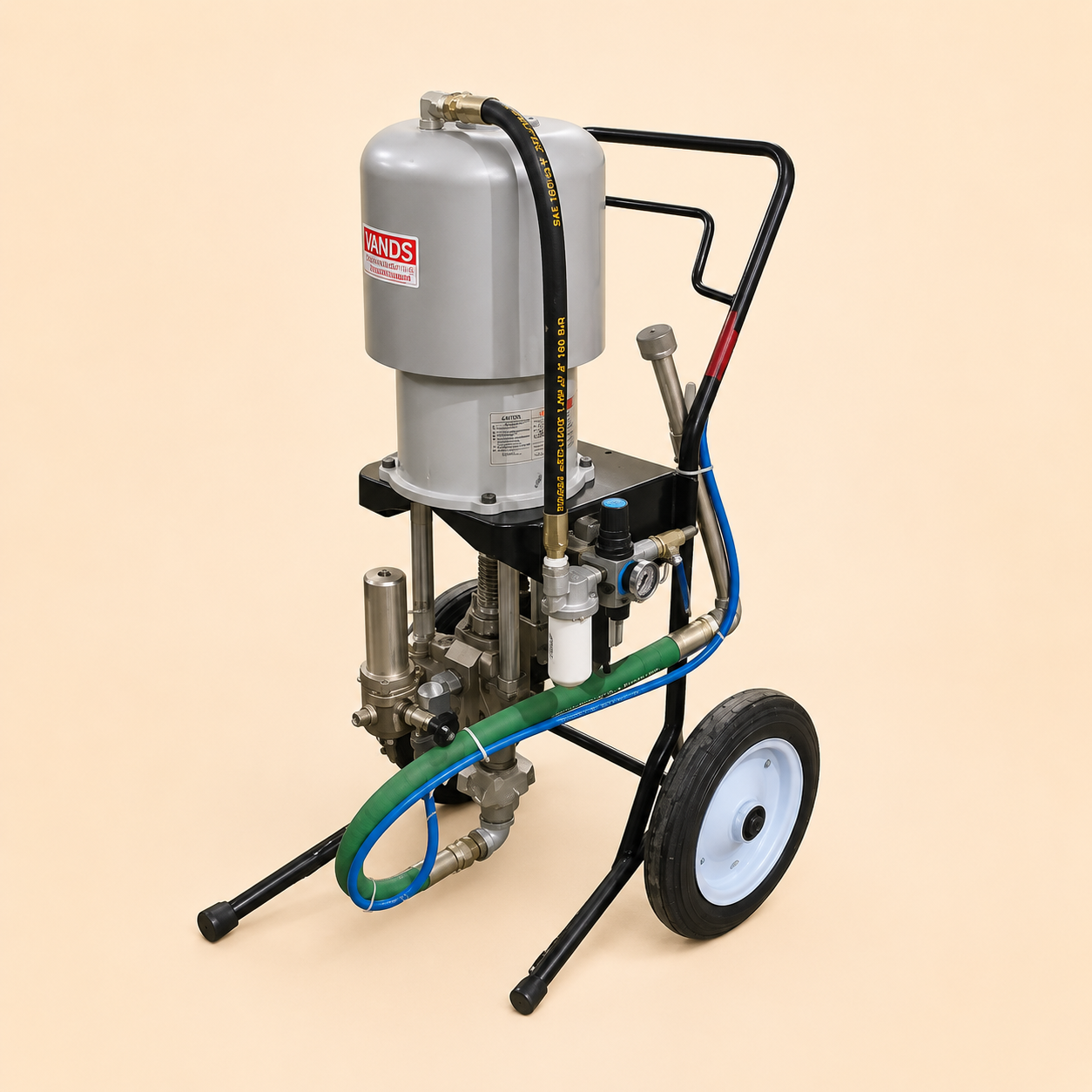
A pneumatic pump has no electric motor. Compressed air drives an air motor, and the air motor drives a hydraulic piston that pushes paint through the tip. Our pneumatic page describes the ratio as how much hydraulic pressure the machine generates per unit of air pressure input.
The figures in our table follow that rule exactly. Each pump is rated with air at up to 6 bar, and 53 x 6 gives the 318 bar listed for the 53:1 pump, while 80 x 6 gives the 480 bar listed for the 80:1. The maximum output pressure therefore depends on the air reaching the pump: feed it less than 6 bar and the paint pressure falls in proportion.
How do our four pneumatic pumps compare?
| Ratio | Output per cycle | Air motor | Stroke | Air inlet (max) | Output pressure (max) |
|---|---|---|---|---|---|
| 53:1 | 220 cc | 250 mm | 120 mm | 6 bar | 318 bar |
| 60:1 | 180 cc | 250 mm | 120 mm | 6 bar | 360 bar |
| 73:1 | 220 cc | 300 mm | 120 mm | 6 bar | 438 bar |
| 80:1 | 160 cc | 300 mm | 120 mm | 6 bar | 480 bar |
All four share a 120 mm stroke. The two higher ratios use the larger 300 mm air motor.
When is 53:1 enough, and when do you need 80:1?
Our pneumatic page states that higher ratios deliver greater fluid pressure for more viscous or fast-setting materials. Read the table with that in mind:
- 53:1: the most paint per cycle in the smaller air motor size, 220 cc, at up to 318 bar. A fit for coatings that spray well at that pressure, where moving material quickly matters more.
- 60:1: a step up to 360 bar, with 180 cc per cycle.
- 73:1: 438 bar while keeping 220 cc per cycle, on the 300 mm air motor.
- 80:1: the highest pressure in the range, 480 bar, with the smallest output per cycle, 160 cc. For the heaviest, high-solid coatings.
The page links high-ratio pumps to intumescent, chemical-resistant and temperature-resistant coatings with high-solid, low-VOC formulations. Compare the spray pressure your coating's data sheet asks for with the output pressure column above, and leave some margin for a lower air supply.
What does your compressor need to supply?
Every pump in the table is rated at a maximum air inlet of 6 bar, so the compressor and air line must hold that pressure at the pump while it runs, not just at the receiver. Air consumption is not printed on the page, so ask us for it against the ratio you choose before you size or hire a compressor. If you are still deciding between electric, petrol and air power, read our guide on choosing an airless machine by the power on site.
Which jobs is a pneumatic epoxy paint sprayer used for?
Our pneumatic page lists protective coatings, industrial paints, epoxy, zinc-rich primers and heavy-bodied materials, on work such as structural steel, pipelines, ship hulls, storage tanks and building facades. Because there is no electric motor, our airless painting machine page describes pneumatic units as suitable for oil refineries, chemical plants and other areas where electric sparks are a concern.
The same page lists a 70:1 stainless steel pneumatic unit with a maximum paint flow of 8 LPM, for structural painting, epoxy painting and marine work.
What should you tell us before choosing a ratio?
- The coating, its manufacturer and the spray pressure its data sheet recommends.
- The air pressure your compressor holds at the pump while spraying.
- Whether the site is a refinery, chemical plant or other area where sparks are not allowed.
- The area you need to coat in a day.
Our team helps select the pump ratio and tip size for your coating and substrate. Once the machine is running, seals and pistons are the parts that wear; our painting machine spare parts page lists them.
Where can you see our pneumatic airless machines?
The full ratio table is on our pneumatic paint sprayer page. Send us your coating and your compressor's working pressure, and we will tell you which of the four ratios fits the job.