Choose an airless machine by the power you will have on site. Where there is a mains supply, an electric paint sprayer is the simplest option and needs no compressor. Where there is no power line, a petrol engine machine works on its own, and where sparks are not allowed, a pneumatic pump driven by compressed air is the safe choice.
How do the three power sources compare?
| Power source | Example from our range | Flow | Pressure | What it needs on site |
|---|---|---|---|---|
| Electric | Vand 915 to Maxcoat | 2.5 to 14 L/min | 227 bar | A mains supply of the right phase |
| Petrol | Model 8900, Honda 5.5 HP engine | 8.3 LPM | 230 bar | Fuel only, no electricity or compressor |
| Pneumatic | 53:1 to 80:1 pumps | 7.5 to 12.5 L/min | 318 to 480 bar | A compressor, air inlet up to 6 bar |
Figures are as printed on each product page. Pressure and flow for the pneumatic pumps depend on the ratio, so check the full table below.
When is an electric airless machine the right choice?
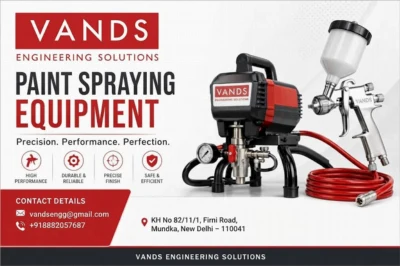
When the site has a steady supply, for example a building under finishing, a workshop or a factory shed. The motor drives the pump directly, so there is no compressor to hire, fuel or move. The range runs from light to heavy units:
| Model | Motor | Flow | Pressure | Weight | Max tip |
|---|---|---|---|---|---|
| Vand 915 | 2.0 kW brushless | 2.5 L/min | 227 bar (3300 psi) | 15 kg | 0.021 in |
| Vands 980 | 4.8 kW brushless | 8.5 L/min | Ask us | 70 kg | 0.049 in |
| Maxcoat | 4 kW induction | 14 L/min | 227 bar (3300 psi) | 93 kg | 0.051 in |
| Maruti | Ask us | About 1.8 LPM | Ask us | Ask us | Ask us |
Before you order, tell us what supply you have. Our Rugged Series covers single-phase and three-phase motors, and the larger models are listed as three phase. The Maxcoat comes with a 3/8 inch by 15 m hose, a gun set and an RAC 517 tip.
When does a petrol airless machine make sense?
When there is no electricity at all: a bridge, a highway, a pipeline route or a rural site. Our petrol engine model 8900 runs on a Honda gasoline engine of 5.5 HP (4875 W) and needs neither a power line nor an external compressor.
- Flow up to 8.3 LPM at a maximum of 230 bar (23 MPa), enough for thick coatings and putty.
- Tip of 0.047 inch with one gun, or two guns on 0.033 inch tips.
- Size 70 × 77 × 96 cm and 97 kg, so plan for two people to move it.
Why choose a pneumatic machine for a refinery or chemical plant?
A pneumatic airless pump has no electric motor. Compressed air from a separate compressor drives it, which makes it suitable for oil refineries, chemical plants and other areas where electric sparks are a concern. The ratio tells you how much fluid pressure the pump builds from the air you feed it.
| Ratio | Output per cycle | Air motor | Spray volume at 50 cycles/min | Max output pressure |
|---|---|---|---|---|
| 53:1 | 220 cc | 250 mm | 12.5 L/m | 318 bar |
| 60:1 | 180 cc | 250 mm | 9 L/m | 360 bar |
| 73:1 | 220 cc | 300 mm | 7.5 L/m | 438 bar |
| 80:1 | 160 cc | 300 mm | 9 L/m | 480 bar |
All four have a 120 mm stroke and take air at up to 6 bar, so size the compressor for that. We also list a 70:1 stainless steel unit with 8 LPM for structural, epoxy and marine work.
What should you check before you decide?
- Power on site: single phase, three phase, none, or a compressor already running.
- Any hazardous zone where an electric motor is not allowed.
- The coating and its thickness, which decide the pressure and tip size.
- How far the machine must travel, and whether two people can lift it.
For matching pressure and flow to the coating once the power source is settled, read our guide on choosing the right airless spray machine.
Where can you see every model?
All three types are on our airless painting machine page, with the electric models on their own pages. Tell us the power you have, the coating and the area you cover in a day, and we will suggest a model.