Dry film thickness equals wet film thickness multiplied by the paint's volume solids: DFT = WFT × (volume solids % ÷ 100). Turn it round and you get the wet target the painter must hit: WFT = DFT × 100 ÷ volume solids %. You check WFT with a comb gauge while the paint is still wet, and DFT with a digital gauge once the coat has cured.
What is the difference between DFT and WFT?
Wet film thickness (WFT) is the thickness of the coat the moment it is applied. Dry film thickness (DFT) is what stays on the steel after the solvent has evaporated and the coat has cured. The specification is almost always written in DFT, because that is the layer that protects the steel. WFT matters because it is the only number the painter can still change.
What is the formula from DFT to WFT?
- DFT = WFT × volume solids % ÷ 100
- WFT = DFT × 100 ÷ volume solids %
- If thinner is added: WFT = DFT × (100 + thinner %) ÷ volume solids %, with thinner as a percentage by volume.
Take the volume solids figure from the paint's technical data sheet. Do not use solids by weight, which gives a different and wrong answer.
How does a worked example look?
Say the specification calls for 75 µm DFT and the data sheet gives 60% volume solids.
- Target WFT = 75 × 100 ÷ 60 = 125 µm.
- The painter thins the paint by 10% by volume. Target WFT = 75 × 110 ÷ 60 = 137.5 µm.
- During spraying, the crew checks the wet coat with a comb gauge and adjusts their passes until readings sit at or just above the target.
- After curing, the inspector checks with a DFT gauge. A reading near 75 µm confirms the wet checks were right.
Notice that thinning by 10% pushed the wet target up by 12.5 µm. Crews who keep spraying to the old wet figure end up below the specified DFT.
When should you check WFT and when DFT?
| Wet film gauge (WFT) | DFT gauge | |
|---|---|---|
| When | Immediately after application, while the paint is wet | After the coating has cured |
| Purpose | Correct thickness while it can still be corrected | Confirm the final thickness for acceptance |
| Type on our pages | Stainless steel comb gauge, manual | Digital LCD, battery operated |
| Range on our pages | 25 - 3000 µm | 0 - 2000 µm, model dependent |
| Scale or substrate | Microns and mils | Ferrous and non-ferrous metals |
For most jobs, use both: WFT at every pass, DFT on the finished system.
How do you read a comb gauge on wet paint?
- Place the gauge perpendicular to the freshly coated surface.
- Press it gently into the wet film and lift it off at once.
- Look at the teeth. The film is at least as thick as the last tooth that picked up paint, and thinner than the first tooth that came out clean.
- Read both values from the scale and compare them with your target WFT.
Wipe the gauge clean straight away; our wet film gauge is reusable stainless steel.
What does the DFT gauge on our page measure?
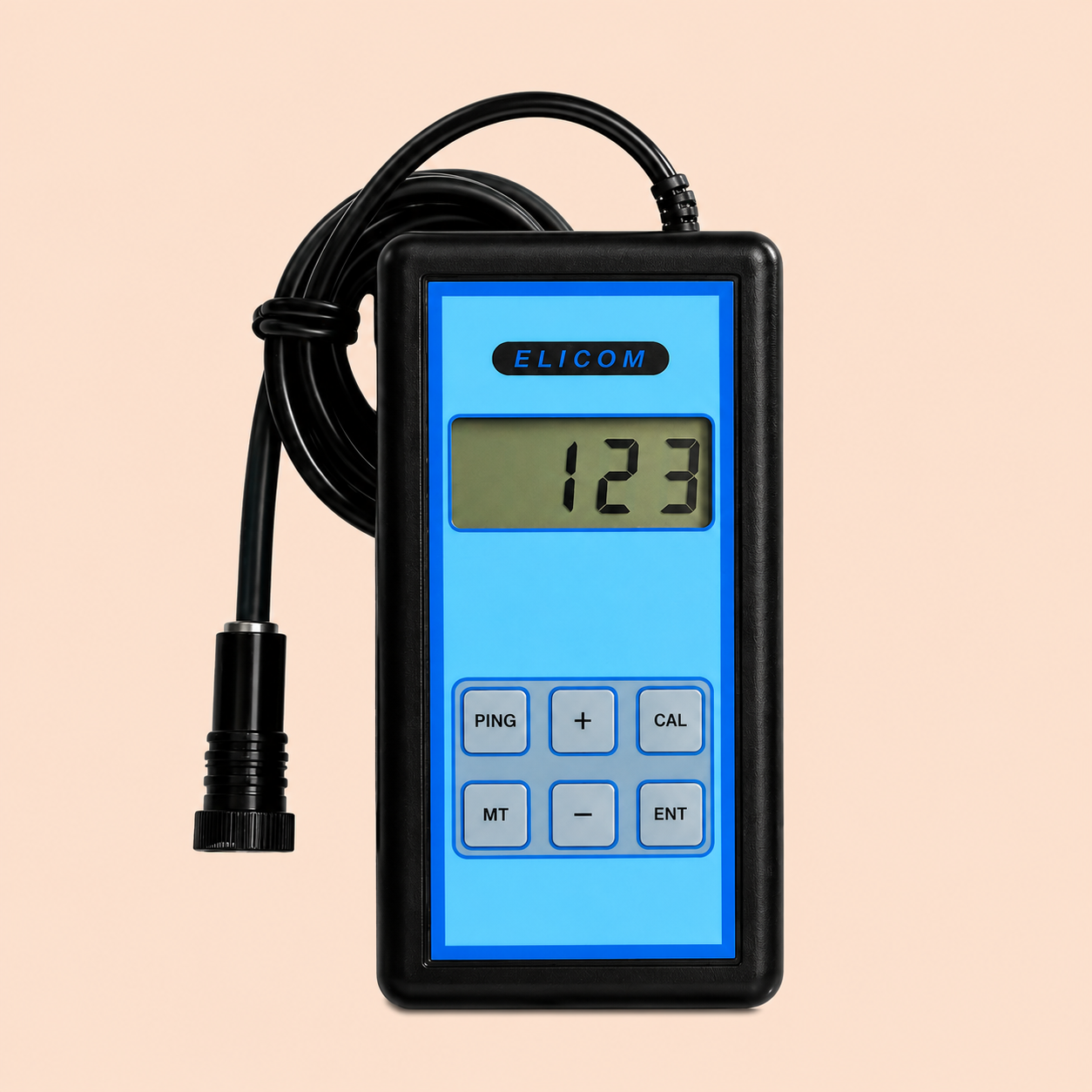
The DFT gauge measures dry paint, powder coating, epoxy, galvanising and protective coatings on metal. The page lists magnetic induction and eddy current measurement, resolution up to 0.1 µm, accuracy of ±1% to ±3%, and zero and foil calibration. Data memory is available on selected models, so ask which one suits your inspection reports.
See both gauges under painting QC test equipment. If you are setting up a coating job from the start, read our guide to surface preparation standards and browse our airless painting machines.