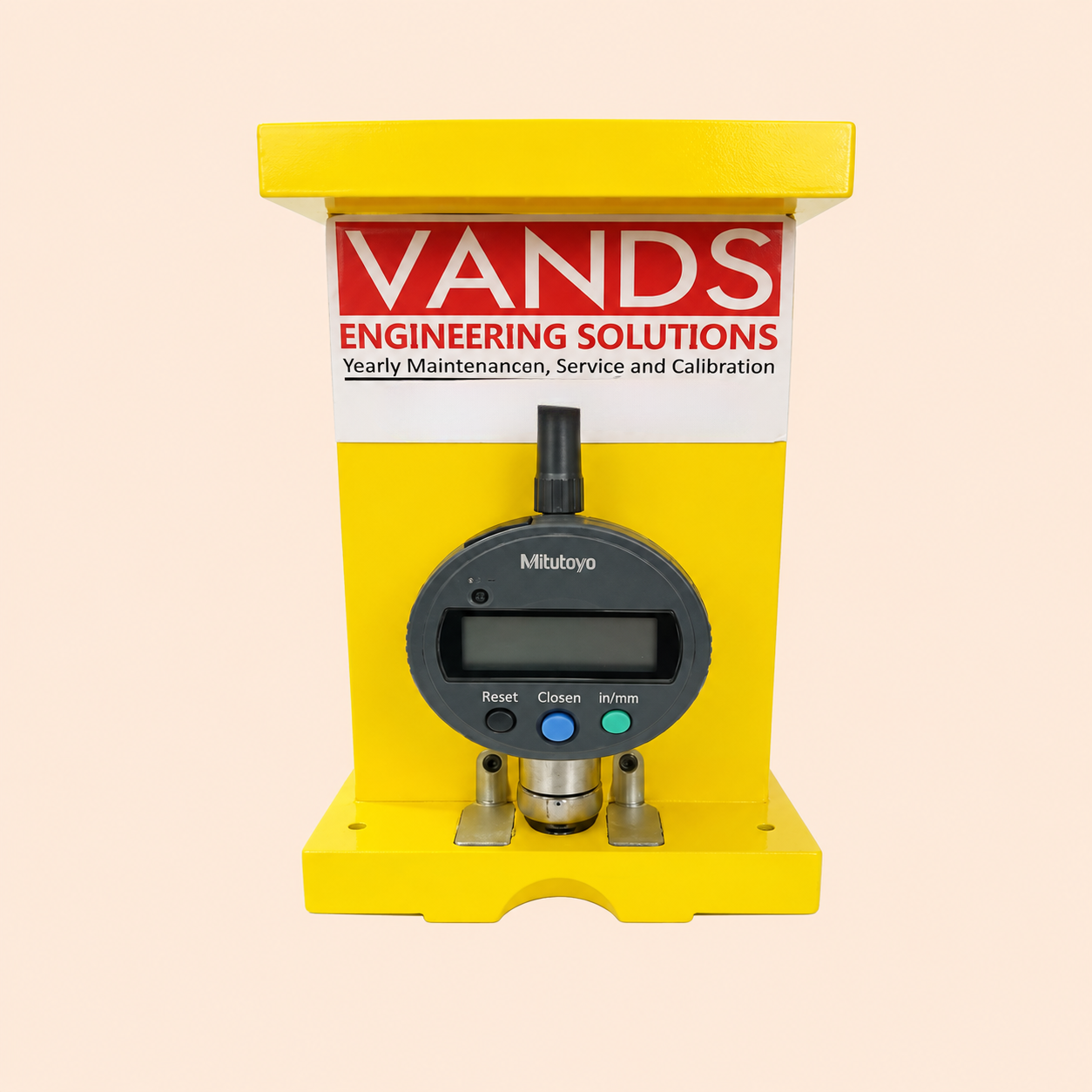
An Almen strip test measures shot peening intensity. A standard steel strip is peened alongside the part, it bends, and the arc height you read on an Almen gauge tells you whether the process delivered the intensity your specification asks for. Use the N strip for low intensity, the A strip for general work and the C strip for high intensity.
What does an Almen strip test actually measure?
It measures what the peening stream does, not the part itself. The strip is exposed to the same stream as the workpiece. As the shot strikes one face it puts that surface into compressive stress, and the strip curves in proportion to the energy applied. The height of that curve, the arc height, is the number you record.
Which strip should you use: A, N or C?
The three types cover different intensity ranges. Your drawing or customer specification normally names the strip, so check it before you order.
| Strip | Intensity | Typical parts |
|---|---|---|
| N | Lower peening intensity | Thin-walled components, delicate engineering parts, precision work |
| A | General industrial peening; the most commonly used strip | Automotive parts, springs, gears, general engineering components |
| C | Higher peening intensity | Heavy-duty components, aerospace structures, large industrial parts, high-stress parts |
Our Almen strips are made from special spring steel, with the thickness of each type set by the A, N or C requirement.
How do you read arc height on an Almen gauge?
- Place the peened strip on the gauge support points.
- Check the strip is seated and positioned correctly before you read anything.
- Read the value on the indicator.
- Record the arc height against the batch, machine and time.
- Compare the reading with the intensity your specification requires.
- If it is outside the limits, adjust the peening parameters and test again before you run parts.
Our Almen gauge uses a Mitutoyo make indicator, with guides and magnetic strip holding so the strip sits in the same place every time. Calibration support is available on request.
Why is one strip reading not enough when you set up a process?
Arc height rises quickly at first and then levels off as exposure continues. A single strip tells you where you are on that curve, but not whether you have reached the flat part of it. That is what a saturation check is for.
- Keep the machine settings, media and strip type fixed.
- Peen a series of strips for increasing exposure times, for example doubling the time from one strip to the next.
- Read each strip on the gauge and plot arc height against exposure time.
- Find the point where doubling the time adds only a small further rise. Your specification states how small that rise must be. The arc height at that point is the intensity.
Once the intensity is set this way, a single strip at the agreed exposure becomes your routine check at the start of a shift or after any change to the machine.
What makes the arc height drift between checks?
When the machine settings have not changed, look at the media first. Peening relies on round particles, and the size and hardness of each particle decide how much energy it delivers. Our cut wire shot is supplied as-cut, conditioned or rounded; the conditioned form is near-spherical and is used for peening springs, gears and other stressed parts. Sizes run from S-70 to S-460 (0.3 mm to 2.0 mm diameter), and uniform pellet size is what keeps the intensity consistent from pass to pass.
Broken or mixed media changes the energy reaching the strip, so a falling reading is often a media problem rather than a gauge problem. Our guide to steel shot or steel grit explains why shot, not grit, is the choice for peening.
Where can you get the gauge, strips and media?
Everything for an Almen strip test is on our product pages: the gauge itself, A, N and C Almen strips and cut wire shot for the peening stream. Send us the strip type and intensity on your specification, and we will help you choose the strips and media.